All articles
Getting started
Planning
Links
Guides
- UTM naming conventions for teams and agencies
- UTM parameters explained
- Campaign launch without broken links
- Planning QR codes for print
- Switch agencies without losing data
- Google Campaign URL Builder or a UTM builder for teams
- UTM links for agencies: running client campaigns cleanly
- UTM management: what it is and when a team needs it
In-house marketing without an agency
Not every company works with agencies. Often the company's own team does everything: marketing, but also sales for a promotion, HR for job ads and the trade fair team for the flyers. The more departments build links, the more important a rule becomes that everyone follows without having to learn it.
The situation
At Lindenholz Küchen five areas build campaign links: social media, newsletter, sales, HR and trade fairs. Most of them do it rarely. HR places job ads on three job boards twice a year, and sales sends out an invitation before every in-house show. The rules for this are known mainly to one colleague in marketing.
What goes wrong
- Whoever rarely builds links guesses. Source and medium are chosen by feel, and "Küchen" becomes "kuechen" one time, "Küchen" the next and "kitchen" after that.
- The knowledge depends on one person. When the colleague goes on parental leave, nobody knows the rules any more.
- Mistakes surface late. Whether a link is built correctly and the landing page works often shows only in the monthly report.
- Every department counts differently. In the end the numbers of HR and sales cannot be put side by side.
How it works with Feinwerk Campaigns
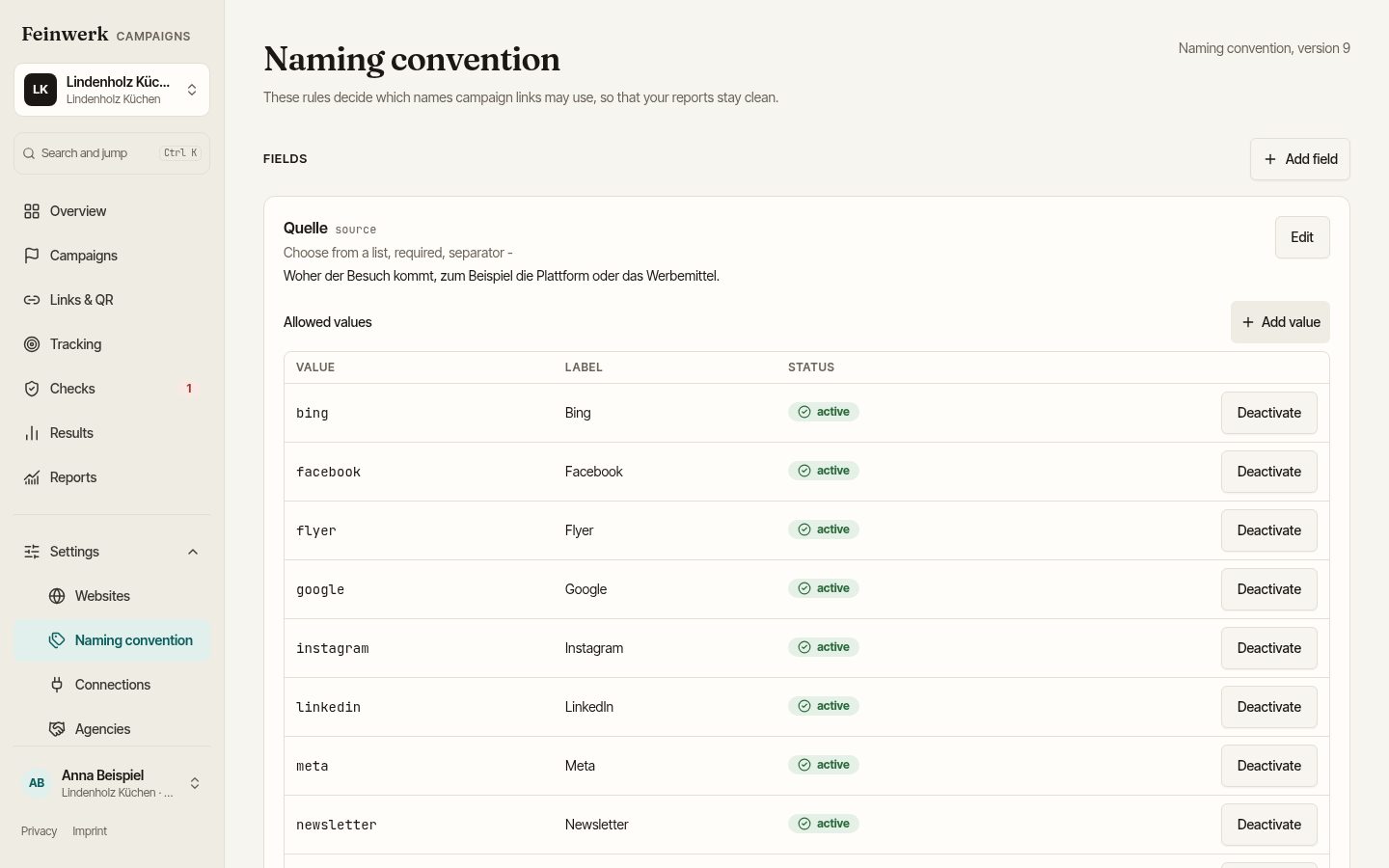
An Admin defines the naming convention once. Everyone else builds links in the link builder and picks source, medium and campaign name from lists with clear names. Every field explains what it expects and shows at once whether a value fits the convention. The values themselves are always lowercase and without special characters: "Frühling" becomes fruehling. So even someone who launches a campaign only twice a year builds it correctly.
If a value is missing, such as a new job board, the person requests it. An Admin approves it, and from then on it is available to everyone. When a link is created, the platform checks the landing page: reachable, parameters still there after the redirect, certificate valid.
Roles control who may do what: Admins maintain the convention, Editors create campaigns and links, Viewers such as management read along. Because you pay per workspace and not per person, all departments can work along at no extra cost.
What you can measure and prove
- One report for all departments: every medium belongs to a channel. The recruiting campaign sits next to the autumn promotion, named by the same rules.
- Results per link: with Matomo you see visits and conversions per link and placement, clearly explained and without Matomo training.
- Ready to start means ready: the start checklist shows per campaign which links are checked and which items are still open.
- Knowledge that stays: convention, campaigns and links stay in the system when someone leaves the team or goes on parental leave.
Next step
More about working with your own team is on the page For companies. What lies behind source, medium and campaign is explained in the guide UTM parameters explained. To get started, use the pilot page.